
The Situation in One Sentence
One week before her nonprofit’s annual fundraising gala, Rachel Thomas had donor information scattered across eleven different PDFs and spreadsheets—but the board expected a single, polished report.
Before: Eleven Files, Zero Story
Rachel works as development coordinator for a mid-sized nonprofit in Chicago that focuses on food insecurity. For the gala, she needed to brief the board and major donors on:
- Top donors from the past year
- New recurring supporters
- Corporate sponsorship totals
- Grant funding awarded and pending
- Impact metrics (meals served, families supported)
The data existed—but not together. She had:
- A PDF export from the donor database
- A separate PDF for corporate sponsors
- Two spreadsheet exports printed to PDF by the finance team
- Three small PDFs with charts made by a volunteer analyst
- A scanned one-pager from the executive director with last-minute notes
Every time Rachel tried to rehearse her talking points, she found herself clicking through multiple windows: “Wait, that chart is in the other file… where’s the sponsor total again?” The information was technically complete, but practically unusable.
What the Board Actually Wanted
The board chair had been clear:
“Give us one document we can read on the plane or print before the meeting. We shouldn’t have to open six attachments to understand our donors.”
The requirement sounded simple: one report, one attachment. But turning those eleven mismatched files into a single, coherent PDF felt like its own project.
The Turning Point: Treating the PDFs Like a Narrative
One evening, Rachel stayed late at the shared office, long after most staff had gone home. She laid out the printed pages on a long table, arranging them into a rough order:
- Overview numbers and impact
- Top individual donors
- Corporate sponsors
- Foundations and grants
- Year-over-year charts
On paper, it finally resembled a story. On her computer, however, it was still a pile of separate PDFs. Rachel opened her browser and went to https://pdfmigo.com.
She uploaded all eleven donor-related files into the tool. Instantly, each page appeared as a thumbnail. Instead of abstract filenames, she saw actual pages she could drag into place.
Building the Gala Report, Page by Page
Rachel mirrored the order she had created on the physical table:
- First, an executive summary and key numbers
- Then, individual donor highlights and giving levels
- Next, corporate sponsor tiers with logos
- Then, a section for grants received and in progress
- Finally, a small cluster of charts showing growth over the last three years
She removed duplicate pages, shifted a couple of charts forward so they would appear next to the relevant sections, and inserted a simple title page that included the gala date and the nonprofit’s logo.
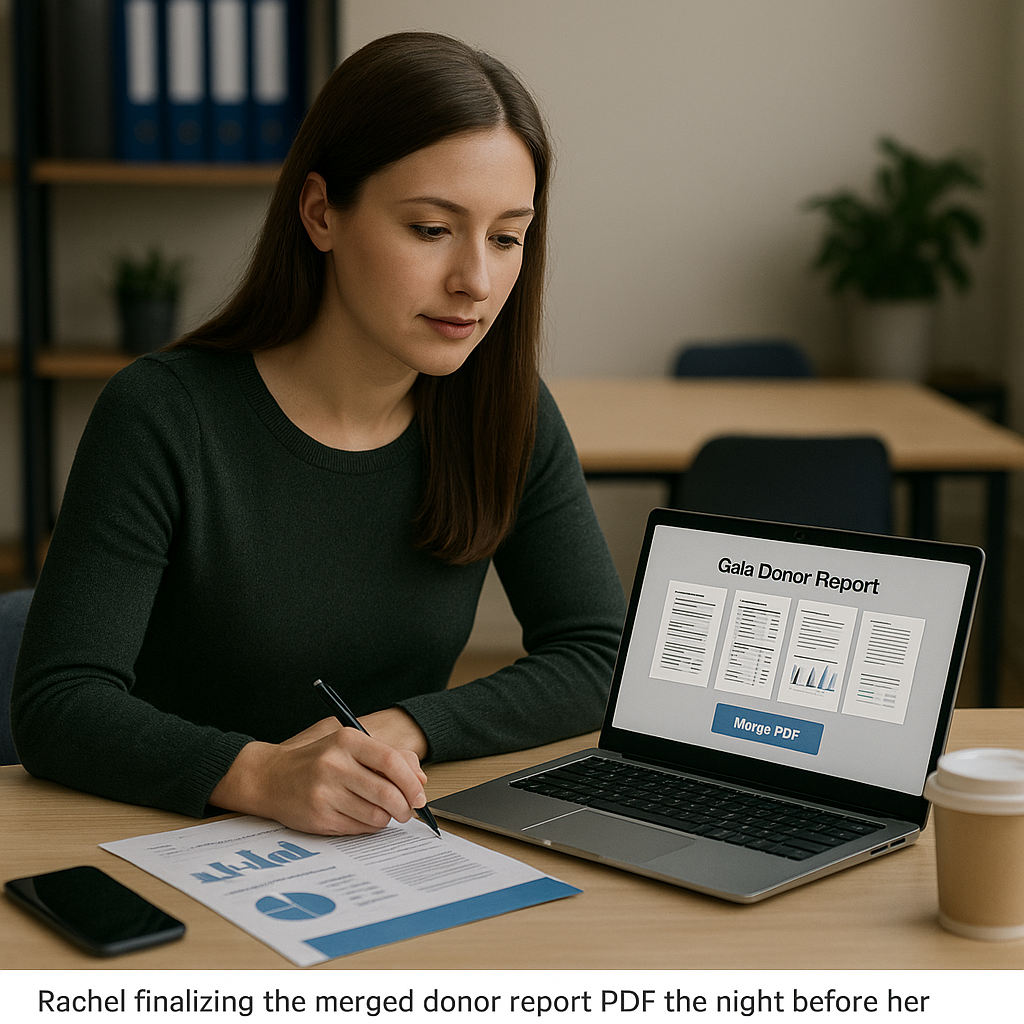
When everything looked right in thumbnail view, she clicked Merge PDF and waited a few seconds.
The download was a single file: 2025_Gala_Donor_Report.pdf—thirty-two pages, in order, with a natural flow.
After: One Attachment, Real Confidence
At the next board prep meeting, Rachel emailed exactly one attachment. Board members opened the file on their tablets and laptops; a few printed it double-sided for their binders. No one asked, “Is there a separate document for sponsors?” or “Where are the charts you mentioned?”
During the gala itself, the executive director quoted directly from Rachel’s merged report in her speech: total dollars raised, percentage increase from last year, and a concise breakdown of where support came from. Everything she needed lived in that one PDF.
For Rachel, the payoff wasn’t just a smoother meeting. It was the shift from feeling like she was “chasing documents” to feeling like she was telling a clear donor story— one any board member could follow, page by page.
Why This Matters for Nonprofits Beyond One Event
Most nonprofits don’t suffer from a lack of data. They suffer from fragmented data—good information split across exports, email attachments, and quick one-off PDFs.
Rachel’s merged gala report became a template: she reused the structure for quarterly updates, grant packets, and partner briefings. The content changed, but the idea stayed the same: one document, one narrative, one place for stakeholders to look.
In a sector where trust and clarity drive donations, that kind of document discipline is more than a technical fix. It’s part of how impact gets communicated—and funded.