
In 2005, the researchers Margo Gardner and Laurence Steinberg asked teenagers and adults to play a computerised driving game. Some played alone, while others played with two same-age peers watching.
The adults’ risk-taking barely changed. The teenagers took noticeably more risks when their peers were present.
It was not just the game that mattered. It was the audience. Teenagers want their choices to count in front of people whose opinion matters to them, and the real question for schools is where that desire can find a meaningful outlet.
Maria Montessori believed the answer was meaningful work. Adolescence, she argued, is made for producing, exchanging and earning, not only for studying. Give a teenager a real product, a real customer and a real chance of failure, and their appetite for challenge has somewhere useful to go. That is the starting point for understanding what enterprise projects in Montessori secondary education are, and why they suit these years so well.
The Adolescent Micro-Economy: What are enterprise projects in Montessori Secondary?
They are real economic operations run by adolescents: growing, making and selling things that other people actually use, and managing the resources behind them. Adults act as mentors and advisers rather than managers, so students carry responsibility within clear limits. Montessori called adolescents doing this kind of work Erdkinder, or children of the earth.
At Blue Blocks Montessori School in Hyderabad, the adolescent community is organised as a working micro-economy, and families looking for a project-based school hyderabad offers can see it at the heart of the secondary years. Its customers are the school community itself: the families, staff and younger children who buy and use what the teenagers make. The market is small, but the consequences are real. When you sell to people you see every day, quality and honesty stop being optional.
This meets two deep adolescent needs. The first is the need to be needed. A younger child may be content to learn for the joy of it, but a thirteen-year-old increasingly asks whether anyone cares about their work. A worksheet that ends in a drawer gives a weak answer, and a product someone pays for and uses gives a strong one. The second is the need for manageable risk. A batch may fail, a price may be wrong, or a product may not sell, and each consequence arrives within a supportive community.
Montessori called the developmental goal valorisation: a young person’s inner recognition of their own worth. It is not self-esteem handed down through adult praise. It grows when work is chosen with purpose, completed with care and genuinely useful to others.
What are examples of enterprise projects in Montessori Secondary?
At Blue Blocks, enterprise is not an after-school club. It is a regular block in the school day, alongside humanities, mathematics, science, sport, and the arts, so students can put what they study in one part of the day to work in another. Four ventures make up the micro-economy.
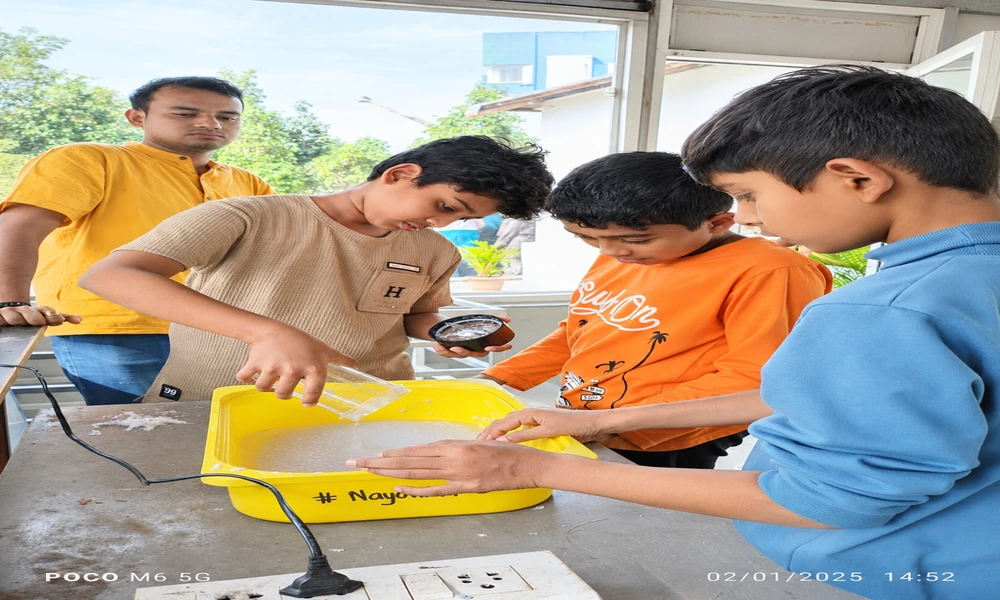
The first is Terra Eutopia, a paper recycling unit where students pulp, dry, and re-form waste paper into new sheets. It rests on a simple idea from nature: there is no waste, only resources in transition. The second is a hydroponics system, where teenagers grow crops without soil, monitoring nutrient concentrations and adjusting pH. Here, an error in chemistry is not a red mark on a test. It shows up in the plants.
The third is an organic farm and plant nursery, where living stock needs care on its own schedule rather than at the students’ convenience. The fourth, the school store, brings the economy together, as students handle pricing, presentation and marketing for the families who buy what the community produces.
How secondary students build responsibility through projects
The simplest answer is that someone else depends on the result. A plant sold as healthy has to be healthy. No venture runs on a single student, so letting your part slip affects the whole group.
That ownership extends into daily community life. Adolescents prepare and eat meals together, hold community meetings for feedback and planning, and end the day by caring for their own workspace. These are ordinary tasks, but they make responsibility visible when everyone relies on everyone else.
Assessment follows the same logic. Students review their own work and weigh feedback from peers and mentors, and the gap between those three judgements is often where the most useful conversation begins. A teenager who rates their own effort highly, only to find that classmates experienced it differently, learns something about accountability that a single grade rarely reveals.
Real-world learning for teens and academic rigour
Real-world learning for teens does not compete with academic rigour. It is where academic learning gets used. Managing hydroponics requires chemistry and biology. Running Terra Eutopia requires mathematics and economics. Marketing the school store requires clear writing for a real audience.
At Blue Blocks, the micro-economy runs alongside the Cambridge pathway in Classes 7 to 10, broadly ages 12 to 16. Students follow Cambridge Lower Secondary and then Cambridge IGCSE in Classes 9 and 10, with IGCSE examinations at the end of Class 10. The aim across these years is economic capability: a practical understanding of value, money and labour, built by running real operations with real stakes.
For parents comparing any experiential learning school hyderabad has to offer, the sharpest question on a campus visit is a simple one: who uses what the students make, and what happens if it is not good enough? At Blue Blocks, the adolescent programme is based at the Tellapur campus, with enterprise built into the school day.
Frequently asked questions
Is the aim of the micro-economy to make money?
No. Money is part of the process because real exchange involves it, but the goal is responsibility, judgement and the experience of producing something others value. A venture that loses money, and teaches students why, can be educationally valuable.
What if my teenager is not interested in business or sales?
Enterprise is not only about selling. A working micro-economy needs students who enjoy science to run hydroponics, students who care about sustainability to manage paper recycling and students who prefer hands-on work to tend the farm and nursery. Each finds a different way to contribute.
How can parents encourage this kind of responsibility at home?
Hand your teenager one manageable household budget line for a month, such as weekly vegetables or cleaning supplies. Agree on the amount and the safety boundaries, then step back and let them plan, buy, track and report on what went right and wrong.
How does enterprise work prepare teenagers for life after school?
It gives them early, low-stakes experience with things most adults learn late: working to a deadline for someone else, handling money honestly, recovering from a decision that went wrong, and explaining their choices to a team. Those habits travel into any field of study or work.
Somewhere useful for the risk
The teenagers in that 2005 driving game were not reckless by nature. They were doing what adolescents are wired to do: testing themselves in front of the people whose opinion matters most to them.
A school cannot remove that drive, and it should not try. What it can do is give it somewhere useful to go. A product that might not sell, a crop that might not thrive, a customer who might not come back: these are real risks, taken in front of peers, with consequences that teach rather than harm. That is what enterprise offers the adolescent years.