
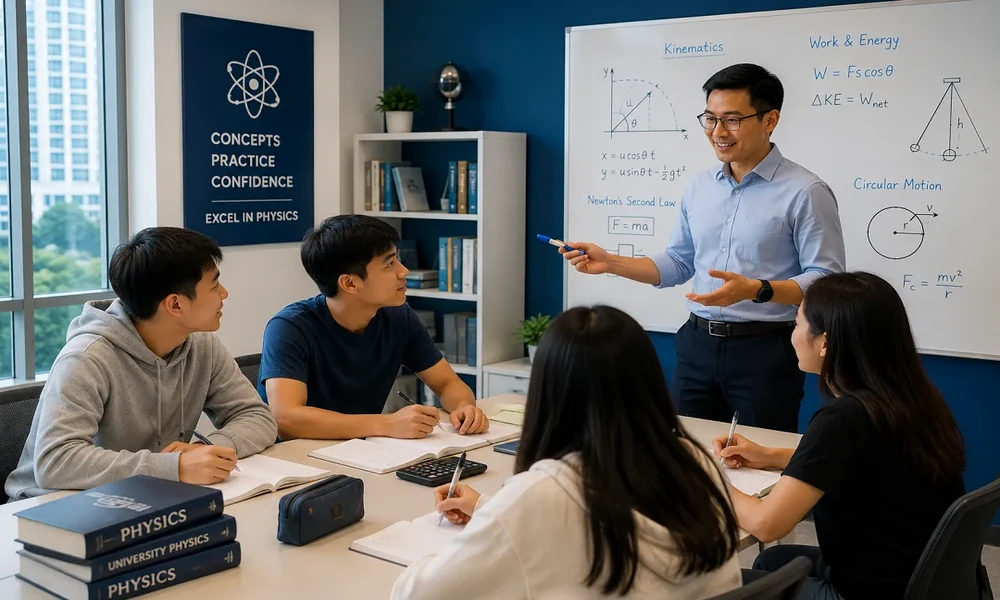
Physics in the Integrated Programme is less about memorising facts and more about solving problems that have not been seen before. Students who struggle are often not weak in understanding but uncertain about how to approach a question that looks unfamiliar. Well-designed ip physics tuition singapore builds problem-solving skills deliberately, giving students a reliable process to fall back on. This article looks at how that support works and why it matters for IP students in particular.
Problem-Solving Is the Core of IP Physics
IP schools design their physics assessments to prepare students for A-level, IB or similar pathways. Without the O-level examination as a checkpoint, schools have more freedom to set challenging, open-ended questions. These often require students to combine concepts, interpret data and justify their reasoning. Problem-solving is not an add-on to the syllabus. It is the main skill being assessed, and students who develop it early tend to find later physics more manageable.
Diagnosing Where Students Get Stuck
Every student gets stuck at different points. Some cannot start a problem because they do not recognise the principle. Others start well but lose track halfway. Some reach an answer but cannot explain it. Good tutoring begins by identifying where each student struggles, often through a short diagnostic assessment. This allows lessons to target the actual weakness rather than reteaching content the student already understands well. A student who scores well on calculations but poorly on explanations, for instance, needs very different help from one who cannot begin a mechanics question.
Teaching a Repeatable Process
A clear process gives students something to rely on when a question seems unfamiliar. A typical problem-solving routine includes:
- Read and restate the problem in your own words
- Draw a diagram and label known quantities
- Identify the relevant principle or law
- Plan the steps before calculating
- Check the answer for units and sense
Practising this routine across topics makes it automatic under exam pressure.
Building Strong Conceptual Foundations
Problem-solving depends on solid understanding. A student who only half understands Newton’s third law will struggle with questions about interacting objects, no matter how good their technique. Effective tutoring revisits core concepts and checks understanding through questions rather than explanations alone. Students are asked to predict outcomes, explain everyday phenomena and identify misconceptions. This depth makes it easier to apply ideas in new settings. Simple demonstrations, such as dropping objects of different mass or tracing magnetic field lines, can make abstract ideas concrete.
Non-Routine Practice Questions
Routine questions, where the method is obvious, have their place, but they do not build problem-solving skill. Strong ip physics tuition singapore programmes include non-routine questions that require students to think before they calculate. These might involve unusual contexts, missing information that must be deduced or multiple concepts combined. Working through such questions with guidance helps students learn how to approach the unknown calmly and methodically. The goal is not speed at first but confidence in choosing a starting point.
Learning to Explain Reasoning
Problem-solving is not just about reaching an answer. IP assessments often reward clear reasoning, and some questions ask students to justify a prediction or evaluate a method. Tutors can help students practise writing concise, logical explanations that link principles to outcomes. This also deepens understanding, because explaining an idea clearly requires knowing it well. Students who can explain their reasoning are better prepared for practical work and later studies. Asking a student to talk through a solution aloud is a quick way to reveal gaps that written answers can hide.
Using Mistakes as Learning Tools
Mistakes reveal how students think. A good tutor examines errors closely to understand the reasoning behind them, rather than simply correcting the answer. Was the principle misunderstood, was the algebra careless, or was the question misread? Discussing mistakes openly helps students develop the habit of reviewing their own work. Over time, they begin to catch errors before submitting answers. Many tutors ask students to correct their own scripts first, before going through the answers together, so the review becomes active rather than passive.
Developing Mathematical Fluency
Physics problems often require algebra, trigonometry and graph interpretation. Students who are slow or uncertain with mathematics may understand the physics but struggle to complete the calculation. Tutoring can strengthen these skills within physics contexts, so students become comfortable rearranging equations, resolving vectors and reading gradients. Improving mathematical fluency frees up attention for the physics itself. Short, regular drills on rearranging formulas or converting units often pay off quickly, since these small skills appear in almost every question.
Tracking Progress Over Time
Problem-solving skills grow gradually, so it helps to track progress. Useful markers include:
- Fewer questions left blank in tests
- Faster recognition of relevant principles
- Clearer written explanations
- Improved scores on application questions
Seeing progress builds confidence, which in turn helps students approach difficult questions with less anxiety.
Choosing the Right Support
Not every student needs the same help, but most IP students benefit from structured practice with feedback. The best support identifies weaknesses, teaches a clear process and provides challenging questions. For families exploring options, a Sec 3 and Sec 4 IP physics tuition class can offer this kind of targeted problem-solving practice alongside the school syllabus.