
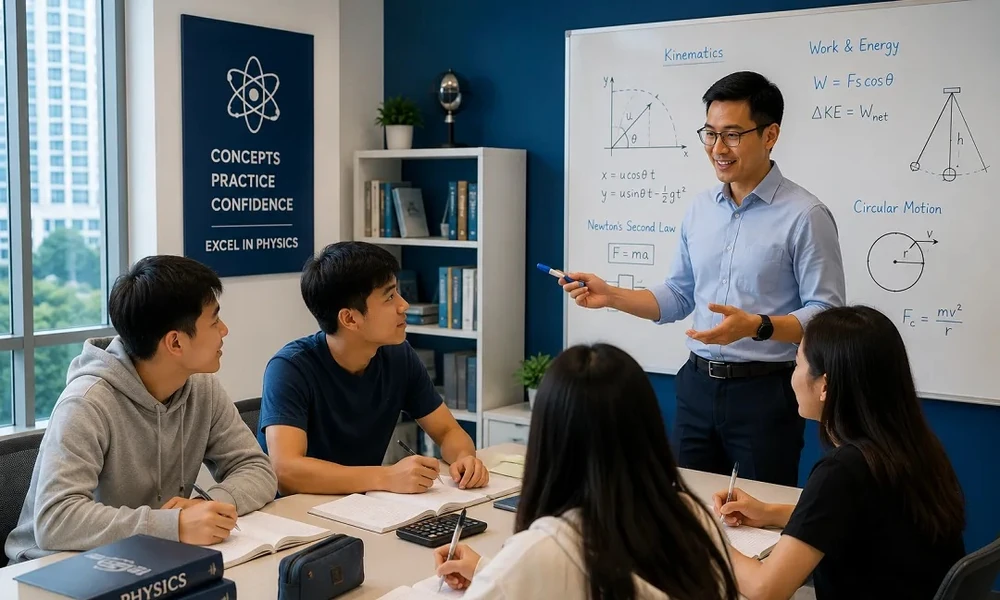
Confidence in an examination hall is not a mood. It is recognition: the quiet sense, on turning a page, of having met this kind of question before and knowing the first line to write. Students who lack it are rarely lazy. They have usually revised by reading, which builds familiarity with notes and none with questions. Well-run o level physics tuition singapore classes aim to manufacture that recognition on purpose, and it helps to see how by walking through a paper from the first minute to the last.
Before the Paper Opens
The nervous student arrives having slept badly and flips through notes at the gate. The prepared one knows the structure cold: which paper is multiple choice, which has structured and longer questions, which is the practical, how long each lasts and roughly how many marks a minute that allows. Tuition contributes here in an unglamorous way, by running full papers under timed conditions several times before the real one, so that the format itself holds no surprises on the morning.
The Multiple-Choice Section: Speed Without Panic
Objective questions test breadth and tempt overthinking. A common collapse is spending five minutes on one stubborn item and rushing the last ten. Training fixes this with a rule: answer what you know on the first pass, circle what you do not, and return. Tutors also teach elimination, since two of the four options are often wrong for an obvious reason such as an impossible unit or direction.
The Question That Looks Unfamiliar
Every paper includes a context nobody has revised: a crane, a kettle, a child on a swing. The physics underneath is always from the syllabus. A confident student has been taught to ask what quantities are given, what is wanted, and which principle links them, be it conservation of energy, the principle of moments or the wave equation. Classes that regularly present old ideas in new settings make this translation routine, so the strange picture stops being a threat.
Showing Working When the Answer Is Uncertain
Marks are awarded for method as well as for the final figure. A student who freezes and leaves a calculation blank scores nothing. One who writes the relevant formula, substitutes with units and gets the arithmetic wrong may still collect most of the marks. In small-group O-Level physics lessons, tutors can insist on full working every time and mark it line by line, until writing the formula first becomes a reflex that survives nerves.
The Six-Mark Explanation
Longer questions ask a candidate to explain or describe, and many students either write three words or fill half a page without hitting the points. The answer scheme usually wants a sequence: state the principle, apply it to the situation step by step, reach the conclusion. Tutors model this aloud, then have students mark each other’s attempts against the scheme. Seeing exactly where a mark is given, and where a paragraph of true statements earns none, removes much of the mystery and therefore the dread.
The Data Question
Tables and graphs unsettle students because the information is not in sentences. Yet these are among the most predictable marks on the paper. Read the axes and units. Identify the trend. Take gradients from the line of best fit using a large triangle. Quote values from the graph when a question says to use it. A class that hands out an unseen data set every week, with five minutes to interpret it, turns this from a gamble into a habit.
In the Laboratory
The practical is where shaky students feel most exposed, since hands and apparatus are involved and time is tight. Preparation is mostly procedural. Set up, take a trial reading, then record repeated measurements in a ruled table with headings and units. Plot as you go if a graph is required. Leave time for the questions on errors and improvements. Centres with access to apparatus, or that at least rehearse the written planning and analysis, give students a script to follow when their mind goes blank.
The Last Ten Minutes
With ten minutes left, the anxious student rereads the hardest question. The trained one runs a checklist. Units on every numerical answer. Significant figures sensible. No multiple-choice item left blank, as there is no penalty for a wrong guess. Directions stated for forces and currents where asked. This sweep typically recovers a few marks, and it is taught, not instinctive. Tutors who make students perform it at the end of every timed practice are building a routine that runs automatically under pressure.
What Happens Between Papers
Confidence is also built or lost in the days between sittings. Reviewing a paper already taken is wasted energy. A good tutor redirects attention to the next one, with short targeted practice on the two or three areas the student’s own records show to be weakest. Centres that track errors by type, such as definitions, units, graph reading or circuit rules, can tell a student precisely what to do on a given evening.
Signs That Confidence Is Real
A student is ready when timed scores are stable from week to week, not when one good result appears. Look for other signs too. Does the student start questions promptly? Is working shown without prompting? Can a wrong answer be diagnosed by the student unaided? If those are present, tuition has done its work. If not, more exposure to unseen questions is needed. Parents comparing options might read how a structured secondary physics course schedules timed practice, and ask to see a sample marked script.